
Beyond Blood Sugar: Is "Silent Gut Inflammation" Undermining Your Team's Afternoon Productivity?

If you've been in one of my workshops (or read my piece on the 3pm Slump) you'll know I talk a lot about blood glucose. From my experience, stabilising it is still one of the fastest ways to kerb the classic 3pm crash across a team.
But here's the pattern that i've noticed showing up recently in my clinical work: employees who eat high-protein lunches, skip the sugary snacks, and have pretty stable blood glucose and still hit a wall at 2:30pm.
When glucose is stable but the fog isn't lifting, I look somewhere HR strategies almost never go: the gut barrier, and its direct line to the brain via the vagus nerve.

The mechanism: post-lunch inflammation
The gut lining is a single-cell barrier held together by tight junction proteins; a gatekeeper letting nutrients in while keeping bacterial fragments out.
Chronic workplace stress, desk-bound lunches, caffeine reliance, and ultra-processed food can weaken it, a state known clinically as intestinal hyperpermeability.
When that barrier is compromised, bacterial fragments called lipopolysaccharides (LPS) can cross into the bloodstream after eating — a well-documented phenomenon called post-prandial endotoxemia. Human trials show circulating endotoxin rising over the 2–4 hours particularly after a high-fat meal (Erridge et al., Am J Clin Nutr, 2007).
This happens to everyone to some degree, in a healthy gut, the immune system clears it quietly. In a compromised one, it doesn't.

Why this drains cognitive performance
The gut and brain talk constantly via the vagus nerve.
Inflammatory signals from the gut wall activate vagal afferents that report straight to the brainstem, and animal studies show this pathway drives the classic "sickness response" — including suppression of orexin, the neuropeptide that keeps us alert (Grossberg et al., J Neurosci, 2011).
In humans, experimentally raising inflammation produces measurable fatigue, low mood, and slower cognition within hours (Reichenberg et al., Arch Gen Psychiatry, 2001; Dantzer et al., Nat Rev Neurosci, 2008).
That's not laziness. It's a primitive survival response, misfiring at 2:30pm in a meeting.

Why the standard wellness playbook misses it
Mental health apps and standing desks are great, but they just don't touch this pathway. If the gut barrier is compromised, no amount of mindfulness stops the cascade the meal deal lunch just triggered.
Of the hundreds of employees i've run wellbeing workshops for, roughly 45% of employees report regular afternoon fatigue.
And the wider cost is bigger than most HR dashboards capture: the IPPR's Commission on Health and Prosperity found the average UK employee loses the equivalent of 44 full working days a year to presenteeism — roughly 84 minutes of lost productivity per employee, every working day.
From my experience as a workplace nutritionist, I've watched the factors that increase gut permeability (and with it, post-lunch inflammation and afternoon tiredness) become more common in the workplace.
Particularly in fast-paced industries like tech and finance, where ongoing stress and grab-and-go lunches are the norm:

Three levers HR and facilities teams actually control
You may not be able to dictate how much aspirin your team pops or stage an intervention on their Diet Coke habit, but there's plenty you can do to support your team's gut health, and the neuro-inflammation that comes with it, from the top down.
1. Audit the food environment, not just individual choices.
Most catering contracts and meeting-room refreshments are optimised for cost and crowd-pleasing, not cognitive performance — think pastries, white bread sandwiches, and biscuit platters that spike the exact fat-carb combination that drives endotoxin transport.
A 15-minute review of your standard catering order or vending contract (swapping in protein, olive oil-based options, and fibre-rich choices) costs nothing to implement and shifts the default for every employee, without needing anyone to change their personal habits.
I can help carry out a healthy eating workplace food review for you- Get in touch for a free discussion
2. Build recovery into the meeting calendar.
Vagal tone, the body's "rest and digest" switch, needs a genuine gap to activate, not another back-to-back call eaten at the desk.
Calendar defaults matter here: shifting standard meeting length from 60 to 50 minutes, or protecting a lunch block company-wide, is a policy change a manager can make in an afternoon, and it's the kind of low-cost, high-visibility win that shows up in an engagement survey.
3. Make screen-free lunch a leadership behaviour, not a poster.
Wellbeing initiatives fail when they're advice for employees but not modelled by managers.
If leadership visibly steps away from screens at lunch, it gives the rest of the team permission to do the same and it directly counters the "email while eating" pattern that keeps the stress response switched on through digestion (acute stress reliably raises gut permeability in people whose cortisol spikes in response to it — Vanuytsel et al., Gut, 2014).
Though I do love a good workplace poster!
Where this fits into the bigger picture
This is exactly the kind of biology I love bringing into the room because once a team member understands why their gut may be behind the 3pm crash, they stop mindlessly munching on Pringles and start making the swap that actually works.
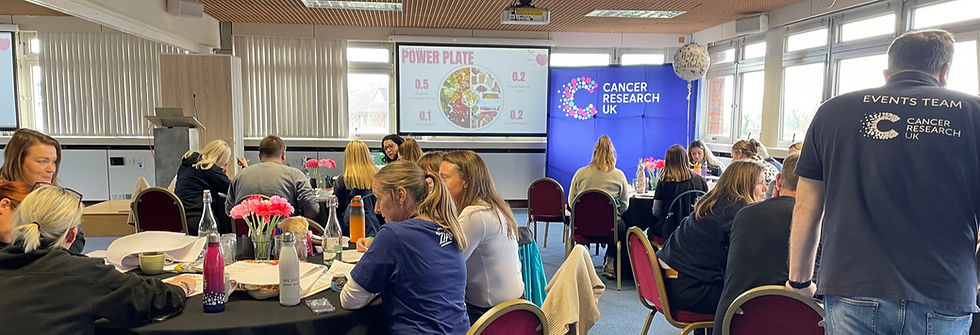
In my workshops and webinars, I use live, anonymous polling to help employees spot their own gut-inflammation red flags in real time (bloating after meals, energy that nosedives an hour after lunch, brain fog that no amount of caffeine touches) then hand them something they can use that same afternoon such as the 4 R's Framework and the "Gut Reset Plate," a simple template for building low-endotoxin, microbiome-friendly & gut-barrier supportive meals without giving up the foods they love.
It's one strand of our Four Pillars Framework for Workplace Nutrition — Metabolic Stability, Cognitive Performance, Stress Resilience, Immune Health — built to give HR and leadership teams a physiological, not just motivational, explanation for presenteeism.
👉 Explore our Corporate Nutrition Workshops or book a Corporate Discovery Call to start revitalising your team!


Comments